
Semrush vs Ahrefs (2026): Which SEO Tool Is Better?
Choosing between Semrush and Ahrefs can be difficult because both are among the most powerful SEO platforms available in 2026. They cover many of the same core tasks, including keyword research, competitor analysis, backlink research, rank tracking, and technical SEO audits, but they approach those tasks differently.
If you are trying to decide whether Semrush or Ahrefs is better, the right choice depends on what you actually need. Semrush is especially attractive for marketers and agencies that want a broad SEO and digital marketing toolkit in one platform, while Ahrefs remains an excellent choice for SEO professionals who prioritize competitor research, backlinks, organic search analysis, and a streamlined workflow.
In this Semrush vs Ahrefs comparison for 2026, we compare their keyword research tools, backlink analysis, competitor research, site auditing, rank tracking, pricing, usability, and ideal use cases so you can decide which platform is better for your business.
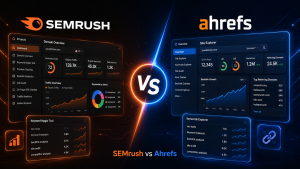
Semrush vs Ahrefs: Quick Verdict
Semrush is our overall pick for businesses, marketers, and agencies that want a broader all-in-one SEO and marketing platform. It combines keyword research, competitor intelligence, site auditing, rank tracking, backlink tools, content optimization, and increasingly important AI visibility features within a single ecosystem.
Ahrefs is an excellent alternative for SEO-focused users who want strong competitor research, backlink analysis, keyword discovery, technical auditing, and an interface that keeps many SEO workflows relatively focused.
In simple terms:
- Choose Semrush if you want a broader SEO and digital marketing toolkit.
- Choose Ahrefs if your workflow is heavily focused on SEO research, competitors, backlinks, and organic search data.
- Choose Semrush for an agency if you need multiple marketing and reporting workflows in the same ecosystem.
- Choose Ahrefs if you prefer a focused SEO research experience and spend a large amount of time analyzing websites and links.
Semrush vs Ahrefs at a Glance
| Category | Semrush | Ahrefs | Our Pick |
|---|---|---|---|
| Keyword Research | Excellent | Excellent | Tie |
| Backlink Research | Excellent | Excellent | Ahrefs |
| Competitor Research | Excellent | Excellent | Tie |
| Technical SEO | Excellent | Excellent | Tie |
| Rank Tracking | Excellent | Excellent | Semrush |
| Content Optimization | Excellent | Very Good | Semrush |
| Broader Marketing Features | Excellent | Good | Semrush |
| Ease of Use | Very Good | Excellent | Ahrefs |
| Best For | Marketers, businesses and agencies | SEO professionals and research-heavy workflows | Depends on your needs |
Semrush vs Ahrefs: Key Differences
The biggest difference between Semrush and Ahrefs is not that one can perform SEO while the other cannot. Both platforms are capable SEO tools. The real difference is their scope and workflow.
Semrush has developed into a broader visibility and marketing platform. In addition to traditional SEO research, users can work with competitor intelligence, position tracking, technical audits, backlink analysis, content optimization, local marketing tools, advertising-related products, and AI search visibility features.
Ahrefs is also expanding beyond its traditional SEO roots, but many users still choose it primarily for its SEO research workflow. Site Explorer, Keywords Explorer, Site Audit, Rank Tracker, and its backlink database form the core of the Ahrefs experience.
Therefore, when you compare Ahrefs and Semrush, the decision often comes down to this:
Do you want a broad marketing and SEO ecosystem, or do you want an SEO-focused research platform?
Keyword Research: Semrush vs Ahrefs
Keyword research is one of the strongest areas for both platforms.
Semrush Keyword Research
Semrush provides several tools for discovering and evaluating keywords. You can research search volume, keyword difficulty, search intent, related terms, questions, competitor keywords, and keyword gaps.
One of the biggest advantages of Semrush is how keyword research connects with the rest of the platform. After finding a keyword, you can move into competitor research, position tracking, content optimization, and other SEO workflows without leaving the Semrush ecosystem.
This makes Semrush particularly useful for content teams that need to move from:
- Keyword discovery
- Competitor research
- Content planning
- Optimization
- Rank tracking
within one platform.
Ahrefs Keyword Research
Ahrefs Keywords Explorer is also a powerful keyword research solution. It can generate keyword ideas and help users evaluate metrics such as search demand, ranking difficulty, traffic potential, and related search opportunities.
Ahrefs is particularly useful when keyword research is closely connected with competitor analysis. You can find the keywords competing websites rank for, identify content gaps, investigate ranking pages, and explore additional opportunities based on existing search results.
Winner: Tie
For pure keyword research, both platforms are strong enough for professional SEO work.
Semrush has an advantage for marketers who want keyword research integrated into a broader marketing workflow.
Ahrefs is particularly attractive for users who want keyword discovery closely connected with competitor and organic search analysis.
Backlink Analysis: Ahrefs vs Semrush
Backlink analysis is another area where both platforms compete directly.
Ahrefs Backlink Analysis
Ahrefs has built much of its reputation around link and website analysis. Site Explorer allows users to investigate a website’s backlink profile, referring domains, organic search performance, top-performing pages, and competing websites.
This makes it useful for tasks such as:
- Finding websites that link to competitors
- Discovering competitor link-building strategies
- Researching referring domains
- Identifying high-performing pages
- Finding potential link opportunities
- Monitoring backlink growth
Semrush Backlink Analysis
Semrush also provides a comprehensive backlink toolkit. Its backlink tools can be used to research competitors, inspect referring domains, evaluate backlinks, discover new or lost links, and audit an existing backlink profile.
Semrush also provides a dedicated Backlink Audit workflow designed to help website owners review links and investigate potentially problematic backlinks.
Winner: Ahrefs
Both tools are excellent, but we give Ahrefs a narrow advantage for users whose day-to-day SEO work revolves heavily around backlink and competitor research.
However, this does not mean Semrush is weak in backlink analysis. For many businesses and agencies, its backlink capabilities are more than sufficient, particularly when combined with the rest of its SEO toolkit.
Competitor Research
Competitor research is one of the biggest reasons to pay for either Semrush or Ahrefs.
With Semrush, you can investigate competitor keywords, organic visibility, ranking changes, backlinks, keyword gaps, and broader competitive opportunities.
Ahrefs Site Explorer also makes competitor investigation extremely powerful. Users can analyze organic traffic estimates, ranking keywords, backlinks, popular pages, competitors, and changes over time.
For example, if a competitor consistently outranks your website, both tools can help answer important questions:
- Which keywords generate their traffic?
- Which pages perform best?
- Which websites link to them?
- Which topics have they covered that you have not?
- Where does your website have a content gap?
Winner: Tie
Ahrefs offers an excellent SEO-focused competitor research experience, while Semrush connects competitive SEO data with a broader collection of marketing intelligence tools.
Site Audit and Technical SEO
Technical SEO problems can prevent good content from reaching its full ranking potential. Both Semrush and Ahrefs include dedicated website auditing tools.
Semrush Site Audit
Semrush can crawl a website and identify technical and on-page SEO issues. This can help website owners find problems involving crawlability, metadata, links, website structure, performance, and other technical SEO elements.
The platform is useful for turning technical issues into an actionable list that can be reviewed and fixed over time.
Ahrefs Site Audit
Ahrefs Site Audit crawls website pages, detects technical and on-page SEO problems, organizes issues, and provides recommendations designed to help users understand what should be fixed.
It also provides an overall health-oriented view of the website, making it useful for regular SEO maintenance.
Winner: Tie
Both solutions are capable technical SEO tools. The better choice will usually depend on which ecosystem you prefer for the rest of your SEO work.
Rank Tracking
Rank tracking allows you to monitor how your website performs for important keywords over time.
Semrush Position Tracking integrates closely with its keyword research and competitor tools. This is particularly convenient for teams that identify target keywords inside Semrush and then want to monitor those keywords as part of the same workflow.
Ahrefs also provides Rank Tracker for monitoring keyword positions and search visibility.
Winner: Semrush
We give Semrush a small advantage because rank tracking fits naturally into its broader campaign and project-management style SEO workflow.
Content Marketing and Optimization
Modern SEO involves more than finding keywords. You also need to turn those keywords into useful content that satisfies search intent.
Semrush has invested heavily in content-related workflows and optimization tools. Depending on your plan and toolkit, Semrush can help with content ideas, on-page recommendations, optimization, and writing-related workflows.
Ahrefs has also expanded its content capabilities and provides tools and AI-assisted features that can support content research and optimization.
Winner: Semrush
Semrush currently feels more natural for teams that want SEO research and content optimization connected within a broader marketing environment.
Ease of Use
A powerful SEO platform is only useful if you can actually navigate it efficiently.
Semrush contains a very large number of tools. That is an advantage for experienced marketers but can initially feel overwhelming to beginners. There are multiple dashboards, reports, toolkits, and workflows to learn.
Ahrefs generally keeps its core SEO workflow centered around major tools such as Site Explorer, Keywords Explorer, Site Audit, and Rank Tracker.
Winner: Ahrefs
For someone who primarily wants SEO research without navigating a larger marketing platform, Ahrefs may feel easier to understand initially.
However, experienced marketing teams may prefer the additional depth available inside Semrush.
Semrush vs Ahrefs Pricing in 2026
Pricing is important because neither platform is a low-cost SEO tool once you move into the full professional plans.
Semrush Pricing
Semrush currently offers its standalone SEO Toolkit in several tiers:
- Pro: $139.95 per month
- Guru: $249.95 per month
- Business: $499.95 per month
Semrush also offers newer packages that combine traditional SEO capabilities with AI visibility tracking. Because Semrush has multiple toolkits and optional add-ons, the final monthly cost can vary significantly depending on the features your business needs.
Ahrefs Pricing
Ahrefs currently lists the following primary plans:
- Lite: $129 per month
- Standard: $249 per month
- Advanced: $449 per month
- Enterprise: $1,499 per month
Ahrefs also has a lower-priced Starter option for users who need more limited access before moving to the main professional plans.
Pricing and plan features can change. Always check the official Semrush and Ahrefs pricing pages before purchasing.
Which Is Cheaper: Semrush or Ahrefs?
The entry-level professional pricing of Semrush and Ahrefs is relatively close, so choosing purely on the monthly subscription price may not make sense.
Instead, compare the features and limits you actually need. A slightly cheaper tool can become more expensive if you need additional users, add-ons, higher limits, or another platform to perform tasks your primary SEO tool does not cover.
Semrush vs Ahrefs for Beginners
Beginners can successfully use either platform, but there are different advantages.
Ahrefs may feel more straightforward if your main goal is learning keyword research, competitor analysis, backlink research, and technical SEO.
Semrush can require more time to learn because there are more tools and workflows available. However, that additional complexity becomes valuable if you eventually want to manage SEO, content, competitive research, and other marketing activities from the same ecosystem.
For pure SEO beginners: Ahrefs can be easier to explore.
For beginners who want to grow into broader digital marketing: Semrush may offer more long-term flexibility.
Semrush vs Ahrefs for Agencies
SEO agencies usually need more than keyword research. They may need to manage multiple websites, track hundreds or thousands of keywords, audit client websites, analyze competitors, build reports, conduct backlink research, and collaborate with team members.
Semrush is particularly attractive in this environment because many different marketing workflows can be managed within the same ecosystem.
Ahrefs remains extremely valuable to agencies that prioritize research and SEO data, especially for competitive analysis, backlinks, organic search opportunities, and content gaps.
Winner for Agencies: Semrush
For a full-service marketing or SEO agency, we would generally choose Semrush because of the broader collection of tools available around the core SEO platform.
Semrush vs Ahrefs for Bloggers and Content Websites
Bloggers need to answer three basic questions:
- What should I write about?
- Can I realistically rank for it?
- What are competing websites doing better?
Both Semrush and Ahrefs can answer these questions.
Ahrefs is excellent for researching competing websites, discovering keywords, analyzing ranking pages, finding content gaps, and investigating backlink opportunities.
Semrush offers many of the same capabilities while also connecting keyword research with content optimization and other marketing tools.
For a blogger focused almost entirely on SEO research, Ahrefs is an excellent choice. For a content business that wants a broader marketing toolkit, Semrush may be the better investment.
Semrush Pros and Cons
Semrush Pros
- Very comprehensive SEO toolkit
- Excellent keyword research capabilities
- Strong competitor analysis
- Technical SEO auditing
- Backlink research and auditing
- Integrated rank tracking
- Strong content optimization workflows
- Broad digital marketing ecosystem
- Growing AI search visibility functionality
Semrush Cons
- Can feel overwhelming for new users
- Professional plans are expensive for small websites
- Some additional capabilities require separate toolkits or add-ons
- Many users may not need every feature available in the platform
Ahrefs Pros and Cons
Ahrefs Pros
- Excellent competitor research
- Powerful backlink analysis
- Strong keyword research
- Excellent Site Explorer workflow
- Useful technical SEO auditing
- Strong content gap research
- Clean SEO-focused workflow
Ahrefs Cons
- Professional plans can be expensive for beginners
- Some users may prefer the broader marketing ecosystem available from Semrush
- Usage limits and additional-user costs should be reviewed carefully before subscribing
Which Is Better: Semrush or Ahrefs?
So, what is better: Semrush or Ahrefs?
There is no universal winner for every user, but Semrush is our overall recommendation for most businesses and marketing teams in 2026 because it combines powerful SEO functionality with a broader collection of marketing, content, competitive research, and visibility tools.
Choose Semrush if:
- You want an all-in-one SEO and marketing platform.
- You manage multiple marketing workflows.
- You want keyword research, auditing, competitor analysis, backlinks, and rank tracking together.
- You run an agency or marketing team.
- You are interested in tracking both traditional search and emerging AI search visibility.
Choose Ahrefs if:
- Your primary focus is SEO.
- You perform extensive competitor research.
- Backlink research is a major part of your workflow.
- You want a focused set of powerful SEO tools.
- You frequently analyze competitor pages, keywords, links, and content gaps.
Ultimately, the best way to decide between Ahrefs vs Semrush is to identify the three or four SEO tasks you perform most frequently and compare each platform specifically for those workflows.
Frequently Asked Questions
Is Semrush better than Ahrefs?
Semrush may be better for businesses, agencies, and marketers that want a broad SEO and digital marketing ecosystem. Ahrefs may be better for users who primarily want focused SEO research, competitor analysis, keyword research, and backlink analysis.
What is the difference between Semrush and Ahrefs?
The main difference is scope. Semrush combines SEO with a broader collection of marketing and visibility tools, while Ahrefs is especially well known for its SEO research workflow, including competitor analysis, keyword research, backlinks, Site Explorer, and Site Audit.
Which is better for keyword research, Semrush or Ahrefs?
Both are excellent for keyword research. Semrush may be more useful for marketers who want keyword research connected with broader campaigns and content workflows, while Ahrefs is particularly strong when keyword research is combined with competitor and organic search analysis.
Which has better backlink data, Semrush or Ahrefs?
Both platforms offer professional backlink analysis. Ahrefs is particularly popular for backlink and competitor research, while Semrush combines backlink analysis with dedicated backlink auditing and a broader SEO toolkit.
Is Ahrefs easier to use than Semrush?
Many users may find Ahrefs easier initially because its core workflow is concentrated around a smaller group of major SEO tools. Semrush provides a broader range of functionality, which can take more time to learn.
Is Semrush or Ahrefs better for beginners?
Ahrefs can be a good choice for beginners who mainly want to learn SEO research. Semrush can be a better long-term choice for beginners who expect to expand into content marketing, competitive research, rank tracking, and broader digital marketing workflows.
Can Semrush replace Ahrefs?
For many businesses, yes. Semrush provides keyword research, competitor analysis, backlink tools, rank tracking, technical SEO auditing, and other functionality that covers many of the same workflows. However, SEO professionals who strongly prefer Ahrefs’ backlink and Site Explorer workflows may still prefer using Ahrefs.
Can Ahrefs replace Semrush?
Ahrefs can replace Semrush for many SEO-focused workflows, including keyword research, backlink analysis, competitor research, rank tracking, and technical audits. However, businesses using Semrush for its broader marketing ecosystem may require additional tools if they switch entirely to Ahrefs.
Which is cheaper, Semrush or Ahrefs?
The main professional entry plans are priced relatively close to each other. Semrush Pro currently starts at around $139.95 per month, while Ahrefs Lite is $129 per month. The true cost depends on plan limits, additional users, optional features, and the specific tools your business requires.
Final Verdict
Semrush and Ahrefs are both excellent SEO platforms, but they serve slightly different types of users.
If we had to choose one platform for a business that wants to manage SEO, competitor research, content optimization, rankings, backlinks, and broader search visibility from one ecosystem, we would choose Semrush.
If the priority is focused SEO research—especially competitor websites, backlinks, keywords, organic pages, and content opportunities—Ahrefs remains one of the strongest choices available.
Our overall winner: Semrush
Best for focused SEO research: Ahrefs
The best choice ultimately depends on your workflow, budget, team size, and which SEO tasks you perform most frequently.